Search This Blog

Sunday, 15 February 2015

Laniakea: Form Experiment 2


In the second form experiment, I made two in Terracotta which were slightly smaller than the first two, and one smaller than these two, witch a pair of much smaller one in pink grog clay. I am planning to make them one by one shorter 2cm than the previous one. 

A pair, like in the following photo, would form a piece of work. By making this small pair, I can see how the work might look like from the front. And I am going to make 6-9, one side of the work, which will allow me to see how they look like from the side. 

Pink grog clay, SW, before firing.
From side
After bisque fire

Pink grog clay, SW, before firing.
This clay, though sometimes lacks of plasticity, is easy to be manipulated. Compared to terracotta, this clay is stronger, because of the grog inside, that the form coming out to be neater. It might be more suitable for me, since I am not really a patient person. Terracotta dries slower than this clay, and if I am not patient enough to wait until the best time to work wit terracotta, that might affect the appearance of my work.


It might also because after making a few of them, I am getting more experienced in making this form, which gives me an illusion that this clay is easier to be used.


In the following image, the right two were made last time, while the left two were made later. They were all made of terracotta. From this side, I can see I had better control in making their shapnow. The smallest one is more closed to what I want to make.

Terracotta, EW, after bisque fire.
However, if you look them from this side, I should do better in estimating the shrinkage and their size. The difference between their height is not clear enough.


In this image, it seems that I need to make at least another two to construct a slope that I want.


The angles of their top are not in the same tendency, or direction. I need to pay attention to that in the following making.


I placed these two bigger one together, just trying different composition.


When I thought about 'how universe was created', one of my idea was perhaps to some creatures, they sacrificed their life, or physical existence to form the universe to other creatures.

Here are two small test pieces I made.

To the left one, these creatures have already piled up into the triangular shape, then their own feature will become blur, eventually becoming the triangular mountain like universe. As to the one on the right, the creatures are still constructing the shape. One is trying to climb on to others. 

To reach the whole idea, there will be some creatures are heading to these creatures' direction, preparing to become the next brick.


The reason I had this idea may to do with the fact that sometimes the society will ask people to sacrifice their own benefits for a group's, or the society's, even the whole human race's benefits. Naturally I would think it is unfair, but some people, they may have no choice, or they can also benefit from it, or they have certain awareness that they are willing to, will support these decisions. I think, partly because of their support, some tremendous things or works can be done. 

Like the crafts men who built the 
pyramid, which might not be the best example. According to some recent research, they had pay, and treated well, even the work was tough.

Thursday, 12 February 2015

Creative Collaboration - 3 The second and third group of test


1. Beet root

Dye: 2 beet roots cooked for 1h.
Fixing: Vinegar and water following the instruction.


1st use: fabric from CAM and calico from Ebay, dyed for 1h, almost invisible pink.
2nd use (stored in fridge): calico, dyed for 4h,  pink got darker.


3rd use: both fabrics, dyed over night, pink is able to seen.


Still, the colour was lighter than I thought. Perhaps beet root doesn't have enough juice that I should use far more than this amount.

2. Plum

Dye: skin from 500g plums, cooked for 1h.
Fixing: salt water, fabric fixed for 1h.


1st use
left1: fabric from CAM, for squeezing, so has uneven and lighter colour.
bottom: fabric from CAM, dyed for 15 mins, slightly lighter than the following two.
right: same fabric, dyed for 1h, pinky purple.


left2: calico, dyed for 1h, showing more colour than the other fabric.

2nd use
right one, dyed for 1h, much lighter pink. Because the dye was not enough.


3. Blueberry

Dye:  add 70-100g blueberries to the original dye, cooked for 1h
Fixing: salt water


1st use
left: fabric from CAM, used for squeezing, light purple.
right: same fabric, dyed for 1h, darker purple


2nd use
right: dyed first,1h,  calico, pinkish purple
left: calico, dyed for 1h, blue (because the dye was not enough)


4. Spinach

 Dye: 2 bags and a half Tesco baby spinach, cooked for 1h
Fixing: vinegar water, fabric cooked for 1h

left: fabric from CAM, dyed over night, light yellow green.
right: calico, dyed over night, light yellow green.


Overall, plum and blueberry produced better colour in my case. Even I used quite a lot of spinach this time, the colour has not come out well. There must be some other things affect the colour, which I have not figure out yet.


Tuesday, 10 February 2015

Creative Collaboration - 2 The first group of test


Initially, I was planning to read the books borrowed from library about natural dye, but I didn't get enough time to do so. In the end, I found some instructions online. It is not ideal, because the books tell more. But on the good side, I know where to find information if I want to go further in the future.

I followed one instruction from all I found, which is:

Make natural dye

1. Chop the fruit or vegetables
2. Add them to the pot with twice as much water. Place over medium heat and simmer for 1hour
3. Turn off the heat, let water come down to room temperature. Squeeze the fruits or vegetables to get more dye

Make fixing: 

4. If the fixing is for fruit, then put 1/4 cup of salt and 4 cups of water.
If it is for vegetable, then use a cup of white vinegar and 4 cups of water. 
5. Boil the fixing, then simmer the fabric in the fixing for 1 hour.
6. Rinse the fabric in cold water, then soak it in the natural dye until wanted colours showing.

Adjustment:

Since I didn't have the white vinegar when we did the first text, we used juice squeezed from 1 lemon instead.


Test 1 - Baby spinach

1/4 bag of baby spinach, cooked about 1h
cotton bought from CAM, fixed by lemon juice
Dyed about 15h


Outcome:

The colour is almost invisible, with very light yellowish green. It might because of the lack of spinach and the way of fixing. I will fix this in the next time.


Test 2 - Beet root

1 beet root for dying ( Tesco organic beet root), chopped, cooked for 30mins
Cotton bought from CAM, fixed by lemon juice for 30mins


First one from left: dyed for 50mins
2nd: 140mins
3rd: 14 hours
4th: 28 hours

The colours were not pink after rinsing. Perhaps one beet root was not enough, and the lemon juice was not as powerful as vinegar.


Test 3 - Blueberry

265g blueberry, cooked for 1h
Cotton bought from CAM, fixed in salt water (as in the instruction) for 1h.


The left one was the fabric I used to wrap and squeezed the berries. Since it was not completely dyed in the solution for enough time, the colour is lighter, bluish and uneven.

The purple has been dyed for 1 hour. It seems the longer you dye and more the berries are used, the more purple the fabric will be.

The colour looked more vivid when the fabric were still wet. Even the colour paled a bit, these two samples were most successful in my first group of test.


It was fun to work with food. The kitchen was filled with sweet fruit smell. At the same time, I should record the amount of the ingredient more accurately,  as a guide for potential improvements.


Thursday, 5 February 2015

Creative Collaboration - 1. Brief


Creative Collaboration - Lin Tao, Yimeng Ou


Aims/Outcomes

Joint: Learn how to do vegetable and fruit dye. The outcome would be like a set design.
Lin Tao: I would like to try food design, which is different from what I am doing now. Food will touch all of the human’s sense, including smell, taste, visual and touch. In this project, I am going to explore the nature material’s taste and colour in Candy Floss. I would like to learn how to record the development of my idea and making process from Yimeng. 
Yimeng Ou: I always want to try natural dye, and this collaboration provides a chance for me to do some research and experiments. I am planning to use fruits to dye cotton fabrics. Then, I will make them into decorations for Tao’s candy floss. Through this project, I would like to learn Tao’s happy spirit during working. 

 Role

Joint: We will make decision, design, and buy materials for dyeing together. During the time we are working together, we will record the process for each other.
Lin Tao: Instead of using chemical products, I am going to give candy floss vegetables and fruits’ flavours and colours. The theme of the candy floss is based on the story of Alice in Wonderland, presenting a narrative environment in food and decorating design.
Yimeng Ou: The dyeing process will be separated, though most of our materials are overlaid. I need to find out how to dye and what kind of materials are suitable. Then I will dye at home. After I finish dyeing, following Tao’s theme, I will make the fabrics into settings for his candy floss.

 Methodology

We would like to work with each other, because we can solve the problem faster. But due to space limits, sometimes we will work separately. However, we will meet three times a week. Also, we will exchange our progress and feedback in time. Progress is mainly recored by sketches, texts, photos, and videos. We will curate and present together in the end.


Here I found some images online which may close to the material, technique I will use.


Sunday, 1 February 2015

Exhibition: Julio Le Parc, Serpentine Sackler Gallery


Serpentine Galleries: 

Julio Le Parc was born in Mendoza, Argentina in 1928 and currently lives and works in Paris where he has resided since the late 1950s.

Julio Le Parc is known for creating artworks that dynamically animate and transform space through light. Featuring seminal installations and interactive works from the early 1960s to the present day, Le Parc’s playful and mesmerising exhibition transformed the Gallery and actively involved visitors. Le Parc began to make geometrical abstract paintings in 1959 based on pre-determined systems, first in black and white, then in colour. In the early 1960s he began working in three dimensions, incorporating moving, projected and reflected lights. From 1964 onwards he began producing works based on distorting mirrors and the displacement of the spectator by means of labyrinths and play rooms.
He is known for using projected, moving, and reflected light to create works of art in constant flux. At the heart of his practice is a desire to experiment with our engagement and perception of art, thereby altering our perspective on the roles of the artist, spectator and the institution. Through his experimentation with light, Le Parc creates a situation of visual instability, in the work and in the viewer’s experience.

The exhibition at the Serpentine Sackler Gallery highlighted the different dimensions in Le Parc’s works, from his politicised drawings and interactive works to his iconic light installations. Experimentation with light as well as the physical involvement and visual stimulation of the spectator have been crucial throughout Le Parc’s career.

Here is the description about the artist I found on the website of Serpentine Galleries. To be honest, I barely knew a thing about this artist before I went to the exhibition.  So this information is for me to study.


The following is made of acrylic sheets, hung down from the ceiling. The sheets kept turning in the air, reflecting the scene around. 
Alternating Lights, 1993
Wood, metal, light
As to this work, the light came out from several thin gaps, changed by the mechanism underneath. 
Continuous Light, 1996
Plastic, wood
This room was filled with mirrors hung in the air. It was hard for me to tell it was path or mirror in front of me that I kept knocked by the mirrors. I was surrounded by endless broken images, which were changing and swinging every second. I had to leave the room because of my headache, but it was interesting to be there.

Reconstruction of a Labyrinth Cell from 1963
Plastic, light, wood
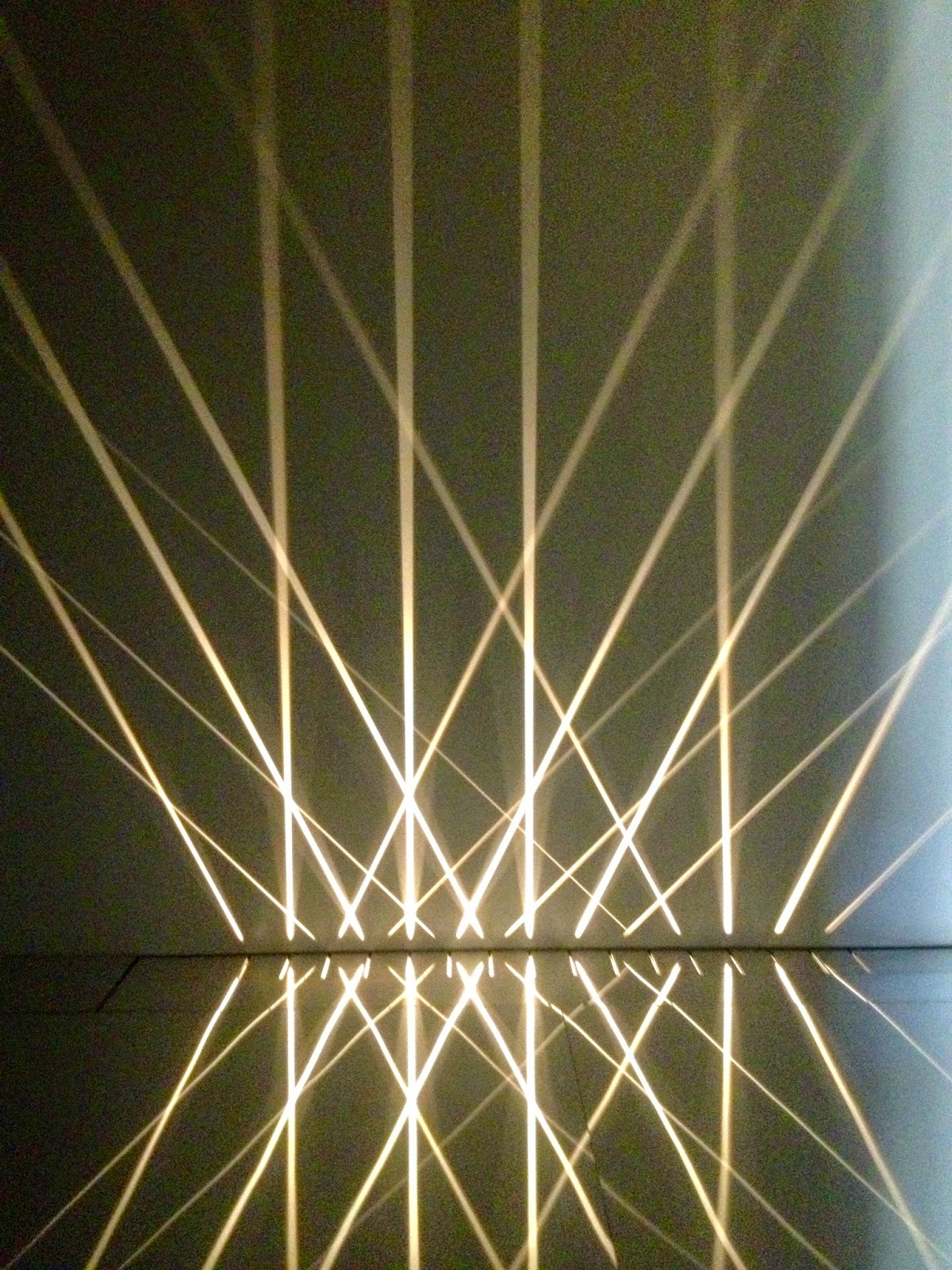
This one is one of my favourite in the exhibition. These thin and almost transparent soft fabric were hold in the air, and some weight was given to each of them to keep them straight. The swimming light strings in the photo were created by a mechanism in the middle. It was like a light in the centre, rotated by a template with hollow patterns. 

I like the quality of the thin fabric, as well as the pale yellow light. The work gave me a sense of vividness, while tranquilly. 

Visualised Vertical Light, 1978
Installation with light
These three pieces are also my favourite. A flexible metal sheet was controlled by some mechanisms that it kept changing its form, like a moving snake. Then two lights shined on the metal from above and blow. Every time the sheet changed, the reflection of light changed.

I like the way that the reflection overlaid each other, construing a rich gradation. They are elegant. 
Continuous Light with Forms in Contortion, 1966-1996
Wood, metal, light


In this work, a lot of mirror paper were strung in the air, keeping swing, as well as their reflection.

Continuous Light Mobile, 1960-1966

I was really impressed about how the light changes in his magic like hands. It was fascinating and remarkable. The materials are quite simple and straight forward, such as acrylic sheets, metal sheets, wood, and light. The light was changed into various forms, and it danced in different ways. With the dark environment and mysterious flux of light, I only wanted to stare at his work, and cannot move my feet.

I was considering since I am going to use some twisted acrylic sticks in my tank to create a sense of spacial confusion, adding more fantasy elements. Maybe I can try to hang some cutting acrylic as well. It might look great if they can reflect and refract the light.