Search This Blog

Showing posts with label Reflective Thinking. Show all posts

Tuesday, 5 May 2015

Laniakea: Design Adjustment


After I had decided the design of the fantasy aquascape, I started to think about how to present the work. Since the tank is going to be quite big, I prefer the steel framed stand to a big chunk of wood plinth. A 1x1x1m plinth would be overly eye-catching.

As some of the work need to be hung in the air, some of the designs have the structure for hanging if there is no existing structure in the show space. Also, I thought about other forms of the tank, bringing some changes rather than just having a square tank. 

After the tutorial, I began to question myself that whether the current design can tell the story. Still, the concept is a little chaotic. It feels like I rubbed too many ideas together but haven't digested them. The design is too safe as well, in term of innovation. 

Based on what I thought, I had two new ideas. 

One will still use the square tank, but the world inside will be divided into three parts. These worlds are in different dimensions. Things to one are like something else to the other. The living beings who live on the bottom of the tank are collecting rocks from rocky mountains pointing down from the sky. To them, the mountains provide rocks for their clothes and houses, but in another aspect, the mountains are universes. They just exist in a mountain form. These mountains to another group of beings living underneath the water surface are sacred that they sacrifice themselves and sustain the mountains. However, to the beings living above the water, the world beneath them is just a reflection of their own world. They are talking and chatting, having no idea that their speech bubbles become new universes. 

The second idea is around the idea of parallel universe bubbles. Say some beings are chatting, no idea that their speech bubbles split into more and more universes. But these beings are also in one of the universe bubbles. I am not going to use glass tank. The tank will be made of ceramic, and with a glass in the front. Ideally, by giving a background to my other ceramic work, there will be a strong connection between the tank and the work. However, there are some technical problems I need to figure out. 


Considering the reality, I listed out the things I need or works I need to make for different designs.


After I had a tutorial with Maiko, I decided to go for the final design. So I refined the design a little. Influenced by a book called A Graphic Cosmogony, I introduced some geometric elements.  


Monday, 6 April 2015

Artist: Leonora Carrington


Leonora Carrington is British-born Mexican surrealist painter. Among her works, I really like her

El mundo mágico de los mayas, finished in 1964. 


El mundo mágico de los mayas was a mural for the Museo Nacional de Antropologia in Mexico City, influenced by the local region and culture.  From a review on Studio International about Leonora's exhibition, it said that 

El mundo mágico de los mayas is the netherworld of Mexico.  The review also mentioned about her miserable life during the war affected her later work. 


Without knowing anything about her and her work, I was naturally attracted by the painting. The world has sky red as blood, land and mountains like the desert. There are surreal creatures, something like a green dragon, a unicorn, a phoenix and other flying beasts. There are people on the ground, black crosses behind them. God-like beings are enlightening them or guiding them to somewhere. The painting is not dark to me at all. I can feel a spiritual redemption from the work. I like the softness of edges and colour. The sense of light and hope there is touching me as well. 


When I tried to find some information about the painting, I found this video that is interesting in a way. In the video, someone was asking Leonora about the inheritance of her talent, her understanding of the work. But Leonora told her that she shouldn't try to intellectualise art and she will never understand by that way. You should understand things by your own feeling. Say a painting is a visual world, but you are trying to turn it into an intellectual world, which is not. 

This conversation reminds me how the academic study here requires us to peel off things layer by layer and reach the answer deeply underneath. Sometimes I wonder is the true motivation, the true answer we are after or we are justing telling ourselves so.  David, our English tutor, sent us an article called Against Interpretation by Susan Sontag, which I should read it. 


I am a person more relying on my feeling more than my intellect. If I feel nothing about something, why would I care the story behind it. But I need to think about how my audiences feel and think about my work. I started to think that to what extent, I want my audiences understand my work. How much supporting information should I give to help them understand. With a keyword like Mexico netherworld, I can connect the visual information on the El mundo mágico de los mayas with my experience, trying to understand it. Even without the keyword, I can still figure out something which is making sense to me. Or I can just simply enjoy the painting itself.


Friday, 3 April 2015

Artist: Glenn Kaino


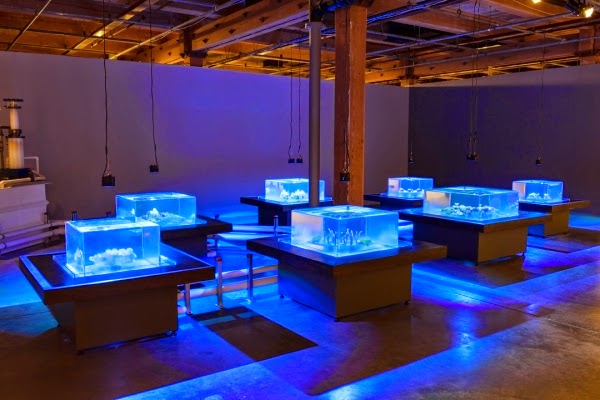
Glenn Kaino is a Los-Angeles-based conceptual artist. The following images show is work Tank (2014), which includes seven marine aquariums, with coral living inside. The setting inside the tanks are simple but have a strong visual impact. There are two aspects of his work catch me. 

One is the way he installed the equipment for the aquariums. There is no filter or heater can be seen in normal aquariums. The lighting system is quite invisible as well. By doing this, he reduced the visual interference that the viewer can easily focus on his work.


The other aspect is he broke the requirement that people would normally ask for the aquarium and aquascape, which is clarity of the tank. People nowadays can choose aquariums made of opti-white glasses that can give them a much more clear view of the tank. Doesn't like standard glass, opti-white glass has no green hint on it. After the aquarium has been set up, it is normal that the algae will grow, on the glass, rock, plants, and such. So people are recommended to clean the tank once a week, especially wiping the glasses. 

What is different here is that I think he let the water overflow the tank, giving the tank a poetic, ice-cube feeling. Because of the running water on the glasses, I cannot see the things inside clearly. But just because of this, there is an unusual beaty in his work.

To sum up the reason I got attracted by his work is that he exaggerated the difference between an artwork and an ordinary aquarium. I think this is worth learning.


Other refer: 
http://thecreatorsproject.vice.com/en_uk/blog/military-machines-become-coral-reefs-in-glenn-kainos-tank


Wednesday, 25 February 2015

Creative Collaboration - 5 Presentation day


This was how our tea party finally looked like. The rest of my fabrics were used as tablecloth and napkin. Tao and I specially went to Ikea and bought some glassware back for the party. He prepared fruits, home-made cap cake, juice, flowers, candy floss. I brought tea, and decor I made before.

These were images we took before the presentation. Everything was ready, apart from the candy floss. To keep them fresh, we decided to make them just before the presentation.


Tao was using his natural dyed sugar to make candy floss. This photo showed that he was trying to make candy floss wrap around the branch on the hare's head.


This was how it looked later.


Then the tea party began. As a part of the project, we invited our tutor and classmates to taste the food and drink we prepared. They specially enjoyed the juice, cup cakes and the candy floss. During the time of eating, we finished our presentation. I am satisfied with all we have done. It was a happy and wonderful experience. 


The pink candy on the top was a happy accident found during making candy floss. Some of the sugar was too heavy to form the floss that it was spun on the wall of the machine, together form this crystallised candy. 


This was the photo I took afterwards. over-left food, the marks of juice on the glass, and withered candy floss showed a scene quite different from the beginning, a sense of decay, and ending. 


Juice marks on the table. 


 Summary

We have two aims. One is learning how to use fruits and vegetables as dye. I dyed fabrics and made them into decorations. Tao dyed sugar, and made candy floss. Together, we presented a Mad Tea Party, inspired by Alice in Wonderland. Another aim is having fun.

In the process of making, I found it was hard to fix the colour after dying. I boiled the fabrics in salt/vinegar water for an hour first, depending on the dye was made of fruits or vegetables. This process will help fix colour. At the same time, I cooked the dye solution for an hour. After I rain the fabrics with water, I put them into warm dye solution for one hour or more. The recipes of natural dying were found online, which didn’t explain everything. I did borrow some interesting books from the library about dying with natural materials, but I didn’t finish them. However, if I want to learn more about natural dying next time, I know where to find the knowledge. Tao had difficulty to dry and sieve the dyed sugar. Because the candy floss machine requires dry and fine sugar to operate correctly. 

Apart from those problems we had, we also had a lot of fun. I noticed that if I spilled a little water on the dyed fabric, the colour will change from blue or purple to green, which accidentally gave some variation to the colour. Tao found that when the dyed sugar was not dry enough, it was to heavy for the machine to form “clouds”. However, the dyed sugar was spun on the cover around the machine, and formed some coloured, transparent candy which looked really good. We also made a lot of by-products during making, such as jam, juice, icing for cake. Being related to food truly cheered us up. For the Mad Tea Party table setting, we went to IKEA together, purchasing suitable glass tableware. I really enjoy all of the experience we shared. 

Though We didn’t really follow the plan, our aims have been achieved. Or maybe in this case, the plan is not important anymore, with less stress, but more joy and feeling. There was no given theme that we can do whatever we like, and in whatever way we like. Our classmate suggested that perhaps we can consider doing a performance, showing the process. Also showing an end of the tea party could be interesting, with left-over food, knocked over glasses, or juice on the fabric. It gives a sense of time, or a feeling that something happened in the past. I would like to develop these ideas, if we have further chances. Overall, I really enjoyed this collaboration, and feel satisfied. It is the best experience of group project I have ever had.


Tuesday, 20 January 2015

Artist: Pierre Huyghe - Aquarium Project


I had no chance to see Pierre's work in person, so I did some research online. The first time I saw he work was about 1 year ago. During the time I tried to find an opportunity of internship or part-time job in Aquarium Architecture. One of Pierre's work was on their website. 

Here is the introduction I found on Wiki about this artist:

Wiki: Pierre Huyghe (born 11 September 1962) is a French artist who works in a variety of media from films and sculptures to public interventions and living systems.


Huyghe has been working with time-based situations and has explored the exhibition process from the 90’s. His works imply such diverse forms as living systems, objects, films, photographs, drawings and music. In recent years, he has created self-generating systems, including living entities and artifacts, in which emergence and rhythm are indeterminate and exist beyond our presence. Taking the exhibition and its ritual as an object in itself, Pierre Huyghe has worked to change the paradigm of this encounter, exploring the possibility of this dynamic experience.


Nevertheless Pierre's work is more from the art prospect, while I am trying to do some artful design. Because he is also working with live ecosystem that it is worthwhile to study his work.  Pierre showed one of his aquarium in Frieze 2011. 

Frieze Project: Pierre Huyghe’s aquarium was a live ecosystem that hosted a specific narrative created for Frieze Art Fair. This narrative was enacted by particular seawater creatures selected as the players in Huyghe’s aquatic performance. —— This is also what I am planing to do. I would like to let animals and plants in my work become actors, playing certain roles in the environment I create for them. However, it is quite often that I could not combine the design of the environment and their role well enough. Sometimes, it is like when I am satisfied with the environment, but there are no certain role for them to play. In a word, it is not easy to balance these two aspects and create a harmony relationship. Perhaps this is one of the ultimate problems I need to solve.

While the conditions in which the players coexisted were constructed within a fictitious narrative, the behavioural relationships between the players were real and not scripted. —— The interesting part for me is that even a role has been given, but the player's action is actually out of control. And that is something I would like to observe for a long time.

Recollection, 2011. Live Marine Ecosystem, Glass Tank, Filtration System. Photo: Guillaume Ziccarelli
Pierre: For this specific tank, the sculpture of Brancusi's Sleeping Muse will rest at the bottom of the tank. It is a shiny head reflecting the surroundings. A giant hermit crab will live within the muse's head and will transport its home all around a brutal landscape. As I was saying, I'm focusing on the animals' behaviours, the biosemiotics. I try to exploit the very basic or essential animal behaviour or need and try to match these behaviours in constructed situations.  ——This is one way of thinking. I realise that perhaps I put more efforts in constructing environment. I probably should use more of their behaviour to create interesting narrative, rather than design the environment first and try to fit them in, is it? Cause I cannot twist their behaviour, even I am not intended to against their nature. But there is some disharmony in the way I am thinking.


Here are another serious of work. 


Pierre Huyghe: IN. BORDER. DEEP at Hauser & Wirth London (2014)
Review by Bill ClarkeFurther into the space are three aquariums, filled with water and plants taken from Claude Monet’s ponds in Giverny. Monet’s ponds were artificially engineered into being in 1893 and became the subject of his Nymphéas series. The aquariums are made of glass that hides their contents when they aren’t illuminated; when they suddenly do light up we see water lilies, and salamanders and fish darting for cover. (We also read that the lighting sequence is  based on the weather conditions recorded at Giverny between 1914 and 1918 when Monet produced the Nymphéas works, but knowing such minutiae about the work doesn’t seem to add much.

Visually, there is a sense of poetry, stillness and mysterious beauty in his work, with misty water, and unconventional lighting system giving lower illumine and curious colour. I especially like the one with salamanders. Someone suggested that maybe I should make the tank I made less like commercial aquarium. I believe I can get some inspiration from here.

I only stepped into fresh water tank, since I know more about this field. While Pierre did many works to do with marine tank. To me, marine tank is another mysterious complicated world. Maybe it is time or in the future for me to corporate with experts who know better. I mean for sure that people have different division in terms of work, and it might be impossible or not necessary for me to become an expert in fish keeping and aquascape. We all need to work with others, but somehow until now I still kept a feeling that I should all do it by myself. Perhaps I should switch a bit.

Tuesday, 2 December 2014

Artist: Richard Slee


Richard Slee (b. Cumbria, UK, 1946) studied at Carlisle College of Art & Design (1964-65) and studies ceramics at the Central School of Art & Design (1965-1970). He graduated with an MA at the Royal College of Art (1988). In 2000 Richard Slee completed a major commission for Sculpture at Goodwood, and in the following year was awarded The Jerwood Applied Arts Prize for his contribution to contemporary ceramics. Slee lives and works in London
Selected group and solo shows include Studio Voltaire (UK), Object Gallery (Australia), Hales Gallery (London), National Museum (Sweden), Victoria & Albert Museum (UK), World Ceramic Centre (Korea) and The West Norway Museum of Decorative Art (Norway).  His work was included in the well-received show, Postmodernism: Style and Subversion 1970-1990 (2011-12), Victoria & Albert (London). Slee's work is represented in numerous collections world-wide, including British Council (UK), Corcoran Museum of Art (New York), Washington Museum of Art and Design (US) and Victoria & Albert Museum (London).

The colour of his work fascinates me. It is really recognisable that his work has well-finished shape, with lush and high-gloss glaze, cutesy characters, and a feeling of innocence, but weirdness. The forms and colours of his work are animated that reminds me Disney, childhood, and candy floss. 

I want to create a colourful fantastic landscape for the aquarium. However, I could not decide should I make the landscape realistic or more abstract. And for my recent pieces, there is a similarity between the form and colour we used that I could learn something from his work.


I really like the uneven texture on his work. To take the image above as an example, the texture on the tree gives the work more detail, and allow the glaze to have some changes.  And since the texture is under the glaze, so it remain as a whole with the rest of the work.

Compared to his work, my piece was not applied a layer of transparent glaze after painted with underglaze. Partly because I like matt finish. But after firing, the finish of the underglaze looked like it was not fired. Besides, matt surface will be covered by algae easier, which looks horrible on candy floss like colour, than the work with glaze on, but harder to be cleaned. I am planning to use glaze next time.


Further reading: http://www.theguardian.com/artanddesign/2012/may/03/artist-week-richard-slee

Tuesday, 18 November 2014

White Chapel Curator Tour: Magnus af Petersens on Richard Tuttle


I booked the curator tour for Richard Tuttle's exhibition in White Chapel Gallery. I am extremely glad that I did it. I mean, even only from the visual aspect, I feel pleased about looking his work. But with a explain from someone who really know his work, his work become more making-sense. 

Photograph was not allowed in this exhibition, and I can only find limited images online. 

According to the curator, the key words of Richard's work are textile, humble materials, making space but not occupying space.

Lable 13-16, 2004-05
Suite of four etchings with aquatint, spitbite,
sugarlift, softground, and fabric colle

16 x 16 in. / 40.6 x 40.6 cm. each
Edition of 25
Among the four works above, I like the one has black triangular the most. It is a joy to see it in person, since it is hard to see the details in the images, like subtile colour changing, difference between materials.  I think this piece has nice colour scheme, well-arranged
 details, proportionally beautiful.


The three images above are his 'walking on air' series. Tuttle describes his new work as being “in a syncretic tradition, where the equal and opposite can co-exist and the abstract and the real are not in a state of ambiguity.” Walking on Air represents for him an “expression of elation for the potential for a new beginning, the possibility to rebuild and discover a harmony for existing in the world today.”  For me, I love their colour and texture. They look like abstract landscape, in the certain time of the day or seasons. The orange one, for example, it is like a longly mountain standing on a vast everglade. It is a sunset in the autumn that they all appear to be strong orange, and clear blue sky lay behind them.


This work is interesting. The ball was stuck in a metal stick, around 1.2m high. There were four lights in red, blue, yellow, and green, on the celling, occupying 4 corners of a non-existing square above the ball. Then these lights were pointing the ball in different directions that the ball has four colours of shadow in the end.

3rd Rope Piece
It is just a small colour rope, against a pale grey wall, and in the write position, it formed a whole space. Personally I found this is amazing, and I love the colour of the rope.

How it gets around the corner, 1996
As the curator said, for minimalism, what you see is what it is. Richard like the things about reveal and conceal, corners, shadow, and things behind. Just like what happened in this work, the fabrics are cleverly sewed and folded, constructing the space behind. I really wanted to see through them, to be honest. 

Overall, though his work is not the kind that normally I would be interested, with the explanation from the curator, I found these works are interesting. And I really like the colour he used. Perhaps I should go more events like this.